Construction Spotlight: The Stacks’ Vision, Design, and Building at an Unprecedented Scale
An interview with Katie Hartley, Managing Director, National Real Estate Development, and Brian Dylus, Senior Director, Construction Management, National Real Estate Development.
The Stacks is a transformative 2-million-square-foot mixed-use waterfront neighborhood redefining Buzzard Point in Southwest Washington, D.C. Located at the confluence of the Anacostia and Potomac Rivers, the former industrial site has been reimagined into one of the city’s most ambitious residential neighborhoods.
Delivered in early 2025, Phase I established a vibrant foundation through the integration of housing, retail, coworking, wellness, and public space, creating an active neighborhood designed to serve both residents and the surrounding community. Developed by National Real Estate Development in partnership with Akridge and Blue Coast Capital, The Stacks reflects years of collaboration, design innovation, and technical execution at an unprecedented scale.
Setting the Vision
Q: National has owned this site for a long time. How did the vision for The Stacks evolve?
Katie: National purchased the site back in 2005 with partners Akridge and Blue Coast Capital. At the time, it was an incredible opportunity—nearly 10 acres in Washington, D.C.—which is exceptionally rare. Over time, as the city evolved and the surrounding neighborhoods matured, our vision evolved with it. What started as a large development opportunity ultimately transformed into what we see today: a thoughtfully planned residential neighborhood that responds to its context and its waterfront setting.
Q: How is the site organized today?
Brian: The overall site is 6.77 acres and was bifurcated into two distinct phases. Phase One, where The Stacks is today, sits on approximately three and a half acres. One of the most important early decisions was how to break down the scale of the site so it felt human and welcoming, rather than monolithic.
Q: What role did design play in achieving that human scale?
Katie: In 2019, a core group from National and Akridge came together to establish the guiding principles for the site. The design team proposed introducing a pedestrian‑only corso that bends through the heart of the development. That move did several things—it created multiple, distinct development parcels, angled buildings toward one another for better light and views, and established a comfortable, walkable ground plane that encourages people to move through and linger.
Q: How do the individual buildings express that vision?
Katie: Each building has its own architectural identity while still contributing to a cohesive whole. The Byron, designed by Morris Adjmi Architects, leans into a more industrial, edgy urban language. The Everly, designed by Gensler, is lighter and more Scandinavian in feel. And the Colette, designed by Handel Architects, is eclectic and bohemian—bold colors, playful details, and a fun, urban energy. Together, they create a neighborhood that feels layered and authentic.
Building at a Massive Scale
Q: Brian, from a construction standpoint, what made The Stacks particularly complex?
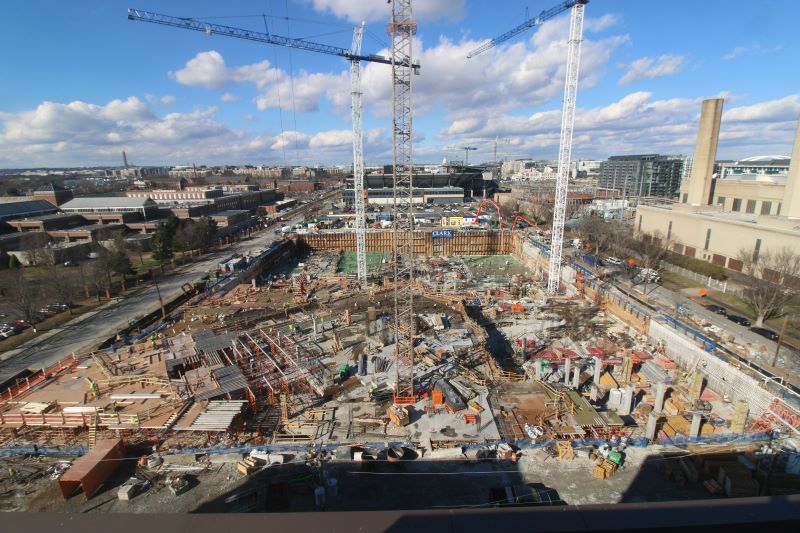
Brian: The scale alone was extraordinary. At the time, this was the largest privately funded development in Washington, D.C. At peak construction, we were pouring concrete in all three towers simultaneously and employing roughly 950 men and women on site.
Q: The site’s location posed unique challenges. Can you talk about that?
Brian: We’re located at the low point where the Anacostia and Potomac Rivers converge, which meant we were dealing with a tremendous amount of groundwater. To excavate safely, we had to dewater the site—essentially lowering the water table before we could even begin digging.
We installed 13 deep water wells and pumped roughly 22 million gallons of water per month out of the excavation. That water was treated and then returned to the DC water system. It was a massive operation, but absolutely essential to making the project feasible.
Q: What does the scale of the finished project look like in numbers?
Brian: Phase One delivered about one million square feet across three residential towers. There are 1,100 residential units with a wide mix of unit types, including co‑living. From an infrastructure standpoint, the numbers really tell the story: nearly 19,000 truckloads of dirt removed, two million linear feet of MC cable, half a million linear feet of conduit, more than 34,000 light fixtures installed, and 66,000 devices.
The amenity program is equally robust—multiple fitness centers, swimming pools, dog runs, fireplaces, grill stations, and a golf simulator. We also incorporated 384 solar panels, which can generate enough power annually to run more than 2,200 60W LED light bulbs.
A New Waterfront Neighborhood
Q: How does The Stacks fit into the broader DC waterfront?
Katie: The Stacks really acts as a bridge—connecting Nats Park and the Navy Yard to The Wharf and the broader waterfront. From the beginning, the goal was to create a place that didn’t just serve residents, but also welcomed the surrounding community.
Q: What have you seen since opening?
Katie: In just the first few months, we started seeing exactly what we hoped for. People from Buzzard Point and nearby neighborhoods walk through the site, bring their dogs, spend time in the public spaces. It’s becoming a focal point—an energetic, lived‑in place rather than a closed‑off development.
Thank you, Katie and Brian!
The Stacks is made possible by master developers Akridge and National Real Estate Development, along with an esteemed group of architects including Handel Architects, Gensler, Morris Adjmi Architects and Eric Colbert & Associates. Capital partners include Akridge, Bridge Investment Group, Blue Coast Capital and National Real Estate Advisors. West 8, Urban Matters, Lee and Associates Inc., Margie Ruddick Landscape, Oehme van Sweden and ParkerRodriguez are the landscape architects. Clark Construction is the general contractor, and Greystar and Akridge are the property managers. For more information about The Stacks, please visit thestacks.com.
For informational purposes only; not investment advice. Selected project highlights aspects of the firm’s development approach; outcomes vary by project and market conditions.